16 Aug Official Rules of Arm Wrestling: The Complete Guide to Rules, Referee Standards & Fair Competition
Arm wrestling is more than a test of strength. At the professional level, it is a disciplined sport built on precise table positioning, controlled starts, strict referee enforcement, and clearly defined winning conditions.
This guide explains the official rules of arm wrestling used for ARMSportsTV competitions, including grip setup, elbow placement, the 60-second call-to-table procedure, fouls, referee responsibilities, tournament formats, and the standards required for fair competition.
Rule sets can vary between federations and leagues. However, these standards provide a reliable framework for athletes, promoters, venues, event planners, and fans who want to understand professional arm wrestling.
ARMSportsTV competition standards at a glance
ARMSportsTV events are designed to deliver competitive integrity and broadcast-ready arm sports entertainment. Key standards include:
- Competitors must be 18 years or older.
- Standard events use a double elimination tournament format.
- ARMSportsTV Super Match events are conducted separately from standard tournament formats.
- Standard events use a minimum of one referee per table.
- Super Match events use a minimum of two referees per table.
- Competitors have 60 seconds total to report to the table and establish a grip.
- A legal pin requires the competitor’s natural wristline to fingertips to touch or pass below the opponent’s touch pad.
- Referee decisions are final during competition.
For complete event documentation, review the ARMSportsTV tournament rules and regulations and the official ARMSportsTV rules document.

1. Competitor eligibility and tournament format
All competitors at ARMSportsTV events must be at least 18 years old. Promoters should verify age, registration, weigh-in status, and required releases before competition begins.
Standard ARMSportsTV events operate as double elimination tournaments. This format gives competitors a second opportunity after a first loss while still producing a clear, competitive path to the finals. The format is especially effective for venues because it creates more matches, more athlete participation, and more entertainment value throughout the event day.
ARMSportsTV Super Match events are the exception. A Super Match is generally built around selected athletes competing in a focused head-to-head presentation, often with one table, dedicated officiating, and stronger broadcast storytelling.
Competitors must weigh in during the designated registration period. No weight allowance is provided unless specifically authorized in the event regulations. Divisions, apparel requirements, and other event procedures should be communicated clearly before athletes arrive.
2. The legal grip setup
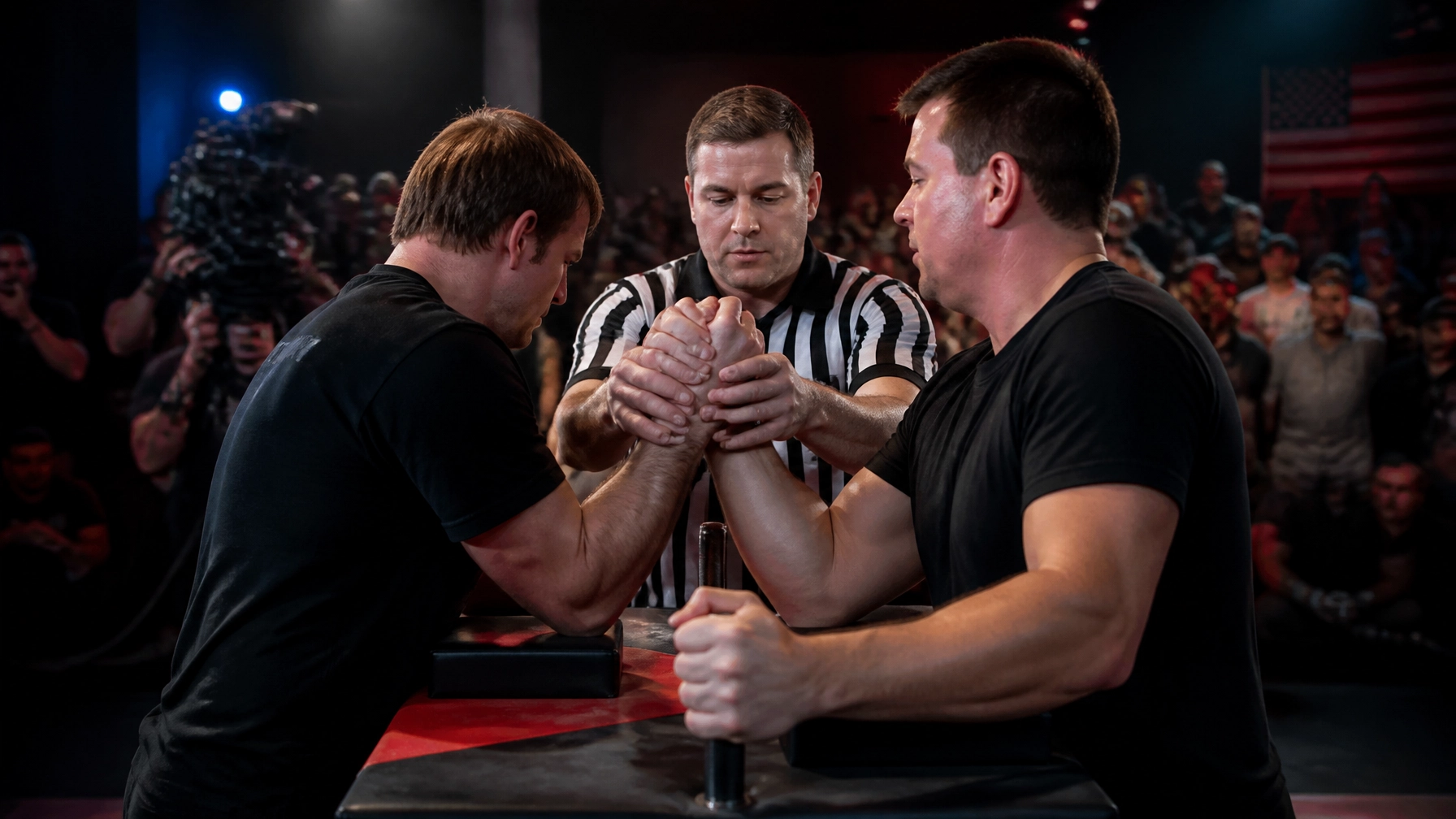
A fair match begins with a fair grip. Before the start command, referees must ensure that both competitors are positioned equally and that neither athlete gains an illegal advantage during setup.
The primary grip requirements include:
- Hands must be centered over the middle of the table.
- Competitors must establish a palm-to-palm grip.
- Thumb knuckles must be visible before the start.
- Wrists must be straight.
- The webbing between the thumb and index finger should be level and properly aligned.
- Competitors must not move during or immediately after a referee’s grip unless instructed.
- The free hand must remain in contact with the table peg unless the referee authorizes otherwise.
When athletes cannot create a legal grip within the allotted grip period, the referee administers a referee’s grip. The referee centers the hands, aligns the webbing, checks the wrists and thumb knuckles, and closes the grip in a controlled sequence.
The referee’s grip is not an opportunity for either competitor to make last-second adjustments. Once the official has established the grip, movement of the elbow, wrist, arm, or hand can result in a warning or foul.
3. Elbow placement rules
Elbow placement is one of the most important elements in professional arm wrestling. The competing elbow must remain on the elbow pad throughout the match.
The elbow may slide across the pad, but it must not lose contact. The elbow also cannot extend beyond the side of the pad when a competitor is riding on the triceps or forearm. Lifting the elbow, allowing it to come off the pad, or moving outside the legal pad area can result in a foul.
Referees also monitor the athlete’s shoulder and body position. A competitor’s shoulder must not cross the centerline between the table pegs. In a neutral or losing position, the competing shoulder cannot be dropped below the level of the elbow pad.
These rules protect the integrity of the match and reduce dangerous body angles. Strength alone does not determine a legal pull; technique must remain within the boundaries of safe competition.
4. The 60-second table and grip rule
ARMSportsTV uses a clearly defined 60-second total procedure:
- The competitor receives the first call to report to the table.
- Thirty seconds later, the competitor receives the second call.
- The remaining time is used to establish a legal grip.
- Failure to report and grip within the required time results in a loss.
Within that overall procedure, competitors are allowed a 30-second period to form their own legal grip. If they cannot reach a proper grip during that period, the referee takes control and administers a referee’s grip.
This rule prevents unnecessary delays and keeps an arm wrestling tournament moving for athletes, spectators, broadcasters, and venue operators. Time discipline is particularly important during televised arm wrestling events, where match pacing directly affects production schedules and sponsor visibility.
5. The start command
The match begins only after the referee gives the official command:
“Don’t move… go.”
Competitors may not initiate the pull before “Go.” A movement before the command is a false start. The first offense may be treated as a warning, while repeated false starts can become a foul under ARMSportsTV regulations.
Athletes must continue competing until the referee stops the match. When a pin or other decisive result occurs, the referee will call “Stop” or “Match” and indicate the winner.

6. How a competitor wins
A pin occurs when any part of the competitor’s natural wristline through the fingertips touches or goes below the opponent’s touch pad on the winning side of the table.
Competitors may not use another part of the body to achieve a pin. The chin, shoulder, head, or any other body part cannot be used to press an opponent’s hand below the pad.
The match continues until the referee makes the call. Even if an athlete believes the result is obvious, competitors should never release the grip or stop pulling before the official signal.
7. Common fouls and warnings
The purpose of fouls is to stop athletes from gaining an unfair advantage or creating an unsafe position. Common competition fouls include:
- Removing the free hand from the peg after a warning.
- Lifting or losing contact with the competing elbow.
- Moving during or immediately after a referee’s grip.
- Failing to straighten the wrist after the grip period.
- Failing to remain centered after the grip period.
- Starting before the official “Go” command.
- Crossing the shoulder over the table centerline.
- Using excessive back pressure to pull the opponent’s arm across the marked center.
- Intentionally delaying the match.
- Pressing one’s own hand into the opponent’s shoulder.
- Dropping the competing shoulder below elbow-pad level while neutral or losing.
- Using the body to pin an opponent.
- Intentionally causing an opponent to foul, such as shoving the opponent’s elbow.
- Using poor sportsmanship, abusive language, or abuse toward an official.
Under ARMSportsTV rules, two warnings equal one foul. In general competition, two fouls result in a match loss. A competitor may lose after one foul if already in a losing position, and intentional slips in a losing position can carry an immediate penalty.
8. Slips, straps, and neutral-zone rules
An intentional slip is prohibited. Examples include opening the hand to create a slip, lifting the fingers before the grip breaks, or closing the fingers into a fist inside the opponent’s hand.
If a grip slips inside the neutral zone, straps may be applied. ARMSportsTV identifies the neutral zone using a clock-style reference between approximately 10 o’clock and 2 o’clock. A slip outside that area may be ruled a loss depending on the position of the hands and arms.
The strap creates a controlled restart and helps ensure that a strong match is decided by arm strength and technique rather than repeated grip failure.
9. Referee standards for fair competition
Professional officiating is essential to credible arm sports entertainment. Referees are responsible for more than calling pins. They control the setup, enforce safety requirements, manage timing, identify warnings and fouls, and protect the competitive experience for both athletes.
At minimum, ARMSportsTV requires:
- One referee per table at standard events.
- Two referees per table at ARMSportsTV Super Match events.
Referees must also avoid conflicts of interest. Under ARMSportsTV regulations, a referee should not officiate a weight class involving a family member or team member if another qualified referee is available. Once assigned to a table, the referee should remain there for the event’s matches unless event management determines otherwise.
For Super Match events, the head referee may override a decision after consulting the down-side referees. This structure adds an additional layer of accountability to high-profile matches.
10. Why rules create better event economics
Clear rules do more than protect athletes. They increase the value of professional arm wrestling for venues, cities, sponsors, and media partners.
A well-run event produces multiple revenue opportunities:
- Ticket sales and VIP experiences.
- Venue food, beverage, and hospitality revenue.
- Local tourism and overnight stays.
- Tiered sponsorship packages.
- Broadcast advertising and commercial spots.
- Product integration and branded content.
- Vendor booths and merchandise.
- Media rights and replay assets.
- Licensing through a turnkey event-in-a-box model.
When the competition is easy to understand and professionally officiated, audiences stay engaged. That makes arm wrestling a stronger property for live events, television production, streaming, and sponsor activation.
Build your next professional arm wrestling event
Whether you are a venue owner, city representative, promoter, athlete, or sports entrepreneur, ARMSportsTV can help turn competitive arm wrestling into a high-impact live and media property.
Partner with ARMSportsTV to:
- Host a professional arm wrestling tournament in your city or venue.
- Produce an arm wrestling super match with broadcast-ready presentation.
- Create a turnkey event-in-a-box licensed package for local execution.
- Develop multi-tier sponsorship and brand activation programs.
- Explore television production and media rights opportunities.
- Train and certify officials for consistent event standards.
Visit ARMSportsTV or review the official rules and event documents to start planning. Bring the world’s largest sport to your market: and build an event that delivers competition, tourism, sponsor value, and arm sports entertainment in one powerful package.
Sorry, the comment form is closed at this time.